Help your child score better in situational writing.
Take a photo of your child’s answer and get comprehensive AI feedback based on the exam rubrics.
Purpose
CorrectAudience
CorrectContext
Correct- Marked on the PSLE situational writing rubrics
- Your school's papers welcome
- Handwritten or typed
Situational writing tests more than writing well.
Content marks go to every required point, for the right purpose and reader. Language marks go to a clear order, the right tone and accurate English. Children often know what to say, but miss a point or use the wrong tone. Playwrite marks both, point by point and slip by slip, so your child knows exactly what to fix.
How it works
 01
Upload the question
Take a photo of the question paper, or choose from our question bank.
 02
Write it, typed or handwritten
Your child types the email, letter, speech or article, or photographs the handwritten page and checks the text before submitting.
- FeedbackContent points5 of 6
- The title of the workshopIncorrect
- The venue of the workshopCorrect
- The dates when you can attend the workshopCorrect
Hello! I hope you are doing fine. Vani and I were disscusing an advertisment ...
03Read the feedback report
A mark out of 14, purpose, audience and context checked, every content point ticked or missed, slips marked on the writing, and a model answer.
See exactly how to improve.
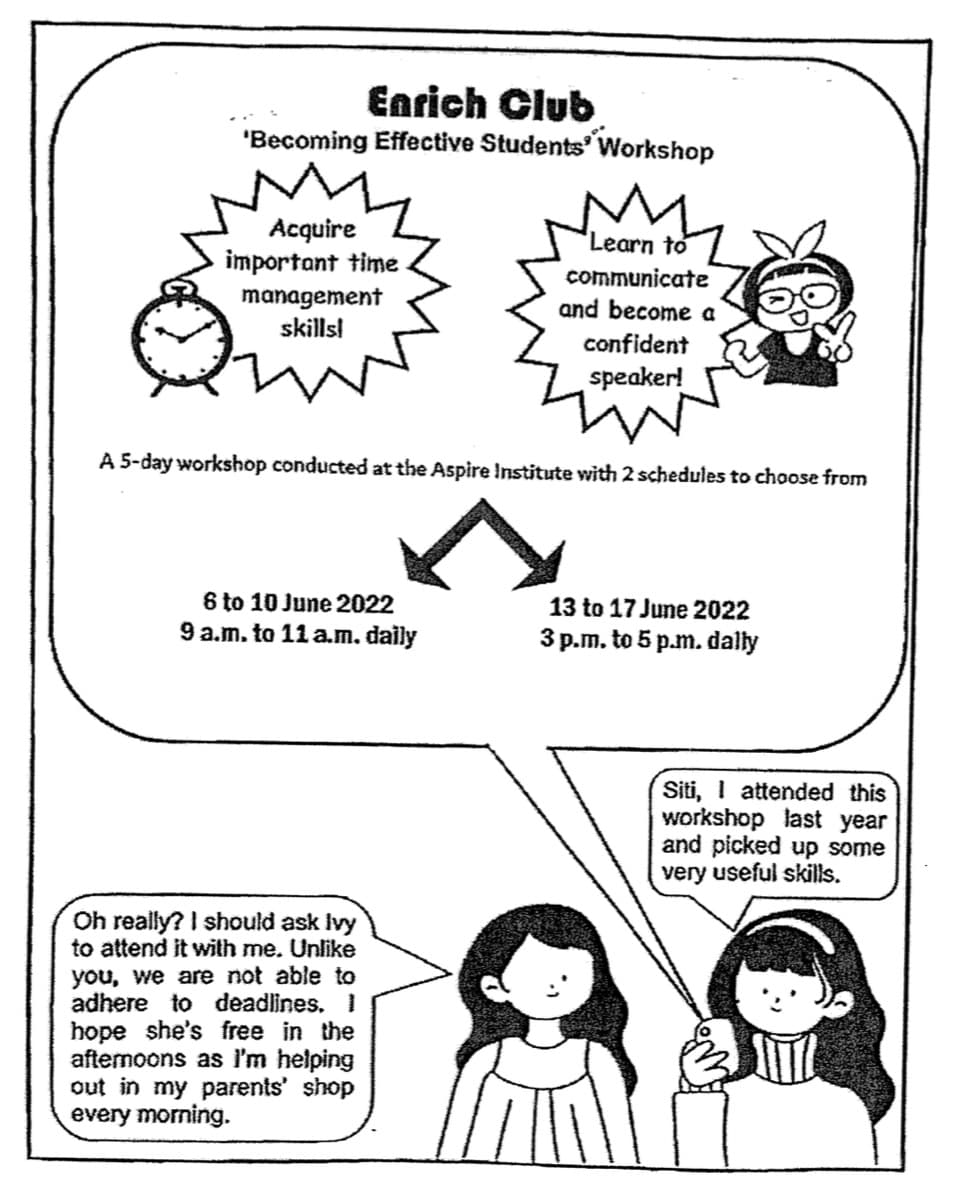
Imagine you are Siti. Write an email to Ivy to encourage her to attend the workshop with you.
Dear Ivy,
Hello! I hope you are doing fine. Vani and I were disscusing an advertisment of a workshop that we saw on a website. I really encourage you to attend the workshop with me!
The workshop is called "Enrich Club" and it is taking place at Aspire Institute. Since I'm helping out in my parents' shop every morning, I thought about attending the class from 13 to 17 June as it takes place in the afternoon during my free time. Through this workshop, we can learn to become a confident speaker. I think we need to learn this as I know that both of us are soft-spoken people and don't usually like speaking up.
If you are interested in attending this workshop, please come back to me as soon as possible. I hope you are able to join me, can't wait to see you there!
Cheers,
Siti
Content points
5 of 6The workshop title is inaccurate. “Enrich Club” is the organiser; the workshop is called “Becoming Effective Students” Workshop.
Model Answer
- Persuade Ivy that the afternoon workshop suits both of you, especially because you need to help at your parents’ shop each morning.
- As Ivy is your friend, begin by asking how she has been and use a warm, casual email style.
Dear Ivy,
How have you been? I saw an advertisement for the ‘Becoming Effective Students’ Workshop, and I think we should attend it together during the June holidays!
The workshop will be held at the Aspire Institute. I can attend the afternoon session from 13 to 17 June 2022, from 3 p.m. to 5 p.m. daily. I am helping out at my parents’ shop every morning, so I can only join the afternoon session. Are you free then?
Built for repetition, not a one-off attempt.
Question bank
Emails, letters, speeches and articles, each with its pictures and helping points, from school papers and our own tasks.
Your own questions
Snap a photo of any situational writing task from school and practise on that exact task instead.
Model answers
Every task comes with a model answer and a suggested approach, to read beside your child’s own writing and spot what to add.
One membership for all of PSLE English.
Situational writing is only one part of the Playwrite membership. The 7-day trial opens every component: 12,000+ questions across all four papers, in MOE exam format and marked on exam rubrics.
- Paper 1
- Composition
- Situational Writing
- Paper 2
- Grammar
- Vocabulary
- Cloze
- Editing
- Synthesis & Transformation
- Comprehension
- Paper 3
- Listening Comprehension
- Paper 4
- Reading Aloud
- Stimulus-based Conversation
Questions parents ask
What is situational writing in PSLE?
Situational writing is the shorter of the two tasks in Paper 1, marked out of 14. Your child is given a stimulus, such as a poster, notice or message, and a task that sets the purpose (to inform, invite, request or complain), the reader and the text type: an email, letter, article, blog post or speech. The task lists the points to include, and one of them asks for your child's own idea rather than information from the stimulus. The marks are split in two:
- Content (6 marks): one mark for each required point, as long as the piece achieves its purpose. A piece that misses its purpose can lose most of these marks even with every point written down.
- Language and organisation (8 marks): format, how the information is grouped into paragraphs, a tone and register that suit the reader, and accurate grammar, spelling and punctuation.
Tone often decides the top marks. Two answers with the same content can score differently if one writes to an uncle as formally as it would to a principal.
How can my child score well in situational writing?
Situational writing rewards a child who thinks about the reader before the words. These are the habits that make the difference:
- Analyse the task before writing. Underline the purpose, the reader and the text type, and tick off each required point in the stimulus. Knowing who the reader is and what the piece must achieve sets the tone before a sentence is written.
- Group points by function, not by bullet order. Strong answers open with the purpose, group the reasons together and the details (date, time, venue) together, then close by linking back. Each paragraph starts with a topic sentence, and a short paragraph is fine.
- Match the register to the reader. A principal gets “I would like to request”; a friend gets “Guess what?” A common slip is explaining what the reader already knows, such as writing “my mother” to an uncle.
- Develop the own-idea point. Give a consequence, a feeling or a recommendation, and fold it into a paragraph rather than tacking it on at the end. Details a real pupil would know, such as a class or a date, can be added as long as they never contradict the stimulus.
- Compare with a model answer. Reading a strong answer to the same task beside your child's own shows exactly what a different tone or order looks like.
Playwrite follows the same steps in every report: purpose, audience and context each checked with a comment, every content point ticked or missed, slips marked on your child's writing, and a model answer to the same task to compare against.