PSLE listening comprehension practice for P3 to P6.
Exam-style recordings that teach your child to catch key details, spot the traps and read between the lines.
You will hear a story about a girl at a neighbourhood festival.
The void-deck festival at Block 12 began at four, and Priya had been sitting on the low wall since half past three with her ukulele on her lap.
- Q1Which picture shows the instrument Priya played?
- Q2Where did Priya perform?
- Q3How did the audience feel while Priya was playing?
- Every Paper 3 question type
- Untried and missed recordings come first
- No limit on listening practice
Most listening practice tests your child without teaching them.
At home, listening practice usually means playing a recording and marking the answers. A score cannot tell your child whether they missed a word, fell for a trap or misread a feeling, so the same mistake comes back. With Playwrite, the report shows what was said, and explanations show why answers were right or wrong.
How it works
- Choose a PracticeListeningListening Comprehension01
Pick a practice
Choose Listening Comprehension on the practice page. Each practice is a new exam-style recording with its own questions.
- Listen
Listen carefully to the recording, then answer the question(s).
0:34 / 1:34Which picture shows the instrument Priya played? 02
02Listen and answer
The questions are on screen before the recording starts, so your child can read them first, as the exam allows. Then they listen and answer.
- Question 3How did the audience feel while Priya was playing?APicture 1Your answerCPicture 3Why the answer is CThe uncles were clapping in time, a toddler was bouncing, the yawning boy was mouthing the words and someone asked for one more, which all show that they were enjoying it. The folded arms were during Mei Qi's violin piece, before Priya played, so Picture 3, the audience clapping and smiling, is correct.03
Read the report
Every answer marked, explanations that point back to what was said, and the recording to play again with its transcript.
See exactly how to improve.
You will hear a story about a girl at a neighbourhood festival.
The void-deck festival at Block 12 began at four, and Priya had been sitting on the low wall since half past three with her ukulele on her lap. She had wanted to borrow her brother Arun's guitar, but it was so large that she could hardly reach the strings, so the small four-stringed ukulele her aunt had given her would have to do.
The organisers had set up a low wooden platform between two pillars of the void deck, with plastic chairs in rows in front of it. Priya had hoped to play on the grass outside the block, where there was more space, but the morning's rain had left it soaked, and the platform under the deck was dry. Her mother stood at the drinks table near the lift, pretending not to look nervous.
Before Priya, a girl called Mei Qi played a slow piece on the violin. The audience sat politely with their arms folded, and a boy in the third row yawned twice without covering his mouth. Priya's stomach tightened as she climbed onto the platform.
She began with a song everyone knew. By the second verse, the uncles in the front row were clapping in time, a toddler was bouncing on his father's knee, and the boy in the third row had stopped yawning and was mouthing the words. When she finished, someone shouted for one more, and Priya, who had only practised one song, played it again.
How did the audience feel while Priya was playing?
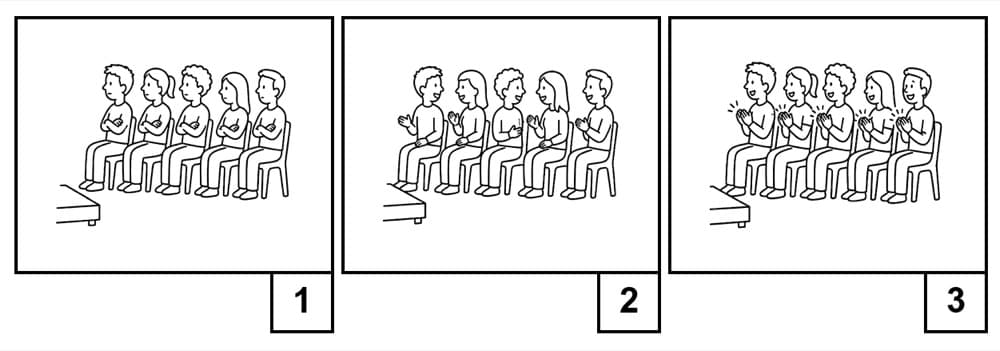
- APicture 1Your answerIncorrect
- BPicture 2
- CPicture 3Correct answer
The uncles were clapping in time, a toddler was bouncing, the yawning boy was mouthing the words and someone asked for one more, which all show that they were enjoying it. The folded arms were during Mei Qi's violin piece, before Priya played, so Picture 3, the audience clapping and smiling, is correct.
Hear it all before the exam.
Picture and route questions
Choose the picture that matches what was said, or trace the route someone took on a map, as the first questions of Paper 3 ask.
Text questions
Conversations, announcements, news reports, interviews, talks, stories and speeches, with questions on what was said, what was meant and the main idea.
Note-taking and sequencing
Write down details from a voice message or a set of steps, and put pictures of events in order, just as school papers ask.
One membership for all of PSLE English.
Listening comprehension is only one part of the Playwrite membership. The 7-day trial opens every component: 12,000+ questions across all four papers, in MOE exam format and marked on exam rubrics.
- Paper 1
- Composition
- Situational Writing
- Paper 2
- Grammar
- Vocabulary
- Cloze
- Editing
- Synthesis & Transformation
- Comprehension
- Paper 3
- Listening Comprehension
- Paper 4
- Reading Aloud
- Stimulus-based Conversation
Questions parents ask
What is in the PSLE listening comprehension paper?
Listening Comprehension is Paper 3 of PSLE English: 20 multiple-choice questions for 20 marks, 10% of the exam, in about 35 minutes. Each recording is played twice, your child has time to read the questions before the first playing, and the first seven questions use pictures or graphics. The syllabus tests understanding at three levels:
- Literal: what was said. A detail stated outright, two details that must both match, or the order of a route or a set of steps.
- Inferential: what was meant. A reason or feeling that is never stated, a plan that changes partway through, or an idiom that cannot be taken literally.
- Evaluative: what to make of it. The main idea of a talk, why it was given and to whom, or the lesson a story teaches.
Playwrite's questions are written to these levels, with the inferential and evaluative questions growing from P5, as they do in the exam.
How is listening tested in P3 and P4?
Why does my child get listening questions wrong after understanding the recording?
Usually because the wrong option was built to be tempting. Listeners tend to pick the option whose words they heard, and exam questions use that:
- The right words on the wrong point. The option repeats a phrase from the recording, but about a different person, place or time.
- The plan that changed. The recording gives one plan, then replaces it. The first version is the trap.
- The feeling from the wrong moment. How someone felt at the start of a story, not at the moment the question asks about.
Knowing the traps helps less than finding them in a recording your child has just heard. That is what the transcript in each Playwrite report is for.
How can my child get better at listening comprehension?
By practising the steps good listeners follow, not only by doing more papers. Research on how learners build listening skill finds this routine helps, and helps weaker listeners most:
- Before: read and predict. Read the questions and work out what kind of answer each needs: a place, a number, a feeling, a reason.
- First playing: catch, and keep going. Note names, numbers and changes of plan. A missed word is not a lost question, so keep listening.
- Second playing: check. Test the chosen answer against what was said, especially an option that only repeats words from the recording.
- After: find the line. For every wrong answer, find the words in the transcript. Was it a word not heard, a word not known, or a trap?
Playwrite builds the last step into every report: the recording and its transcript are there to go back to.