How is a PSLE composition marked?

Your child has written a good number of compositions by now, in school and at home. Some of them you've gone through together. And the mark keeps landing somewhere between 20 and 30, without a clear reason why it goes up one week and down the next.
This is the frustrating thing about composition. Grammar drills work: do enough cloze passages and the cloze mark goes up. Composition doesn't work like that. A child can practise a lot and still not know what to work on, because "develop your story" and "use better vocabulary" aren't instructions. They're descriptions of a mark.
So before the next practice, it helps to know exactly how a PSLE compo is marked: the marking scheme, band by band, and what moves a script from one band to the next.
The PSLE composition marking scheme
Continuous writing is marked out of 36: 18 for content, 18 for language. Schools mark to a variant of the scheme below, and the mark ranges shift by a mark or two from school to school, but the bands and what they describe are the same. At P3 and P4 the same scheme runs out of 10 and 10, with four bands instead of five and more forgiveness about how ambitious the plot is.
Content rubric (18 marks)
| Band | Marks | Criteria |
|---|---|---|
| 5 | 16 to 18 |
|
| 4 | 13 to 15 |
|
| 3 | 9 to 12 |
|
| 2 | 5 to 8 |
|
| 1 | 1 to 4 |
|
Language and organisation rubric (18 marks)
| Band | Marks | Criteria |
|---|---|---|
| 5 | 16 to 18 |
|
| 4 | 13 to 15 |
|
| 3 | 9 to 12 |
|
| 2 | 5 to 8 |
|
| 1 | 1 to 4 |
|
Read the two tables side by side and two things stand out. Half the mark has nothing to do with grammar or phrases. And in the content table, the word that separates band 3 from band 5 is "developed": adequately, well, thoroughly. That is where most of the movement is.
How to score higher for content
Relevance is usually fine if the story is about the topic and stays there. The mark moves on plot development, and it moves for one reason. About half the P5 and P6 compositions we mark are complete stories with a rushed climax or a rushed ending. The comment we write most often is some version of "slow down here and show us one moment".
To improve content:
- Plan the moment, not the plot. Decide which moment the topic is really about, then give it more sentences than anything else.
- Stretch the climax. Give the key moment three beats: what the character does, what they think, what changes.
- End with a consequence, not a lesson. Show what is different now. The moral can come after, but it can't do the work alone.
- Practise on real topics. The same themes come back every year. Every PSLE composition topic since 2015
How to score higher for language
Language marks don't jump around much between two compositions, which is good news and bad news. Good, because the mark is predictable. Bad, because it only moves with steady work.
- Organisation is the cheapest mark to fix. New paragraph when the time, place or speaker changes. That's most of it.
- Accuracy is about what errors do to a reader, not how many there are. One tense slip the reader glides past costs less than a sentence they have to re-read. Fix the recurring habit first: the same error five times weighs more than five different ones.
- Vocabulary and expression is not a phrase list. It's whether the words do work at the moments that matter. A simile at the climax counts. Five similes in the first paragraph count as one habit.
How to do well in PSLE compo: practice and feedback
Two things move the mark: consistent practice, one composition a week from P5, and feedback that says exactly where the marks went. Practice without the second is how a child writes fifty compositions and stays at 24.
Playwrite marks every composition on the bands above, split into five criteria (relevance and plot development for content; organisation, accuracy and vocabulary for language), with a band and a reason for each, then annotates the script itself: the lines that worked, the lines where a technique was available, and a rewrite showing how. Handwritten or typed, marked in about five minutes.
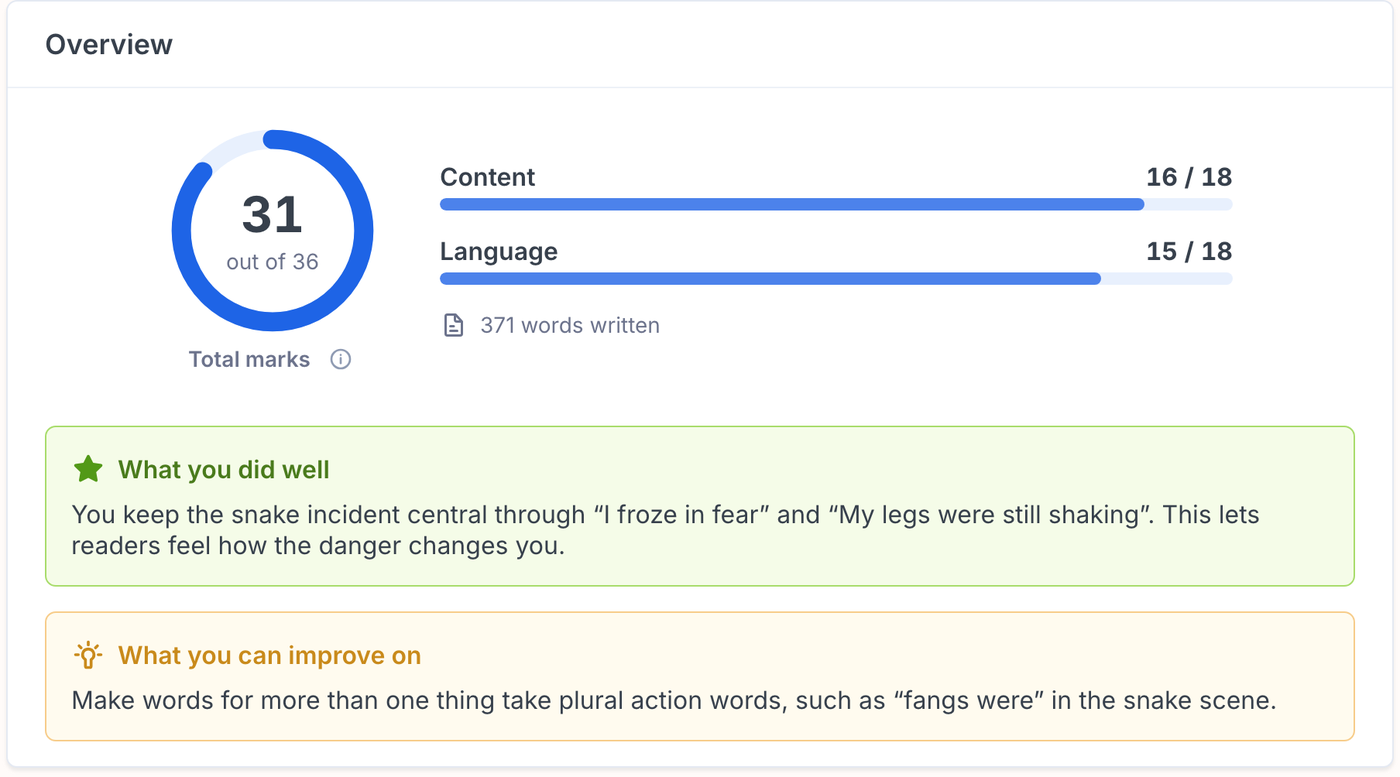
The question bank covers the topics that come back every year, so your child can practise the same theme twice and see the band move. Have one composition marked for free to see where your child's marks are going.
Common questions
How long should a PSLE composition be?
The paper asks for at least 150 words, and markers don't count words beyond that. Most compositions that reach the top content band run between 250 and 400 words, not because length is rewarded but because a rushed climax and ending are what hold most scripts in band 3, and it takes a few hundred words to show them properly. A clean 300 words beats a padded 500.
Will memorising model compositions or good phrases raise the mark?
Memorising whole stories rarely helps: a memorised plot seldom fits the topic and pictures closely enough for the content marks, and markers recognise recycled writing. Memorising phrases helps only if the phrase fits the moment; a good phrase dropped into a rushed climax does nothing for content and can hurt vocabulary if it is misused. What transfers is technique: how to open, how to slow down a key moment, how to end on a consequence.
Does my child have to use all three pictures?
No. The composition must be based on at least one of the three pictures, and using one well is safer than forcing in all three. What matters is that the picture chosen is central to the story's problem, not a passing mention in the first paragraph.
Find out where your child is losing marks before the next exam does.
Playwrite marks compositions, situational writing and oral against the PSLE rubric and shows what to fix in each one. Free for 7 days.